

The Glittering Sphere
Or, sprezzatura?

When I was younger, in my early twenties, I moved through the world with the sense that I was being protected and advocated for by something like a higher being. It inhabited my mind, body, and soul with a radiating glow, and its presence was as rich as tangible light, I could almost touch it. It embodied feelings of protection, awe, hope, excitement, and it simultaneously sat suspended in the gaze of my mind’s eye and wrapped around me like a glowing shell. I referred to it as The Glittering Sphere, this golden orb that bathed me in feelings of protection and opportunity. It was like a home, with a door that let me in to safety and out to adventure.
It was such a full, beautiful feeling and so visually real to me that one day, after my college classes had let out for the summer, I ventured to create a sculptural representation of The Glittering Sphere with my hands. I wanted to create something so transcendentally beautiful it would evoke the same feelings of joy and excitement in others and bring peace. I looked at materials: what was the substance of it, and what was available to me? How to create a spherical structure that could support some kind of glowing essence? My top choice would have been to make it completely out of light, so I moved onto my second choice, which was vaguely “a sphere humble enough not to be distracting or braggadocious, to let the work speak for itself.” So I gathered a handful of sticks from the woods to construct this thing. Natural elegance. It felt important that the beauty of my vision not be marred by any kind of frivolous opulence. Nothing too audacious for this humble orb. I had my sticks and a collection of golden beads, leftover decorations from a wedding reception I had worked at my golf course job the previous summer. I found some gold thread and gold paint, plenty to work with to make this thing shine.
If I’d had the mind of an engineer I would have used first principles to determine how to assemble the sticks into a sphere, which would have exposed immediately the folly in the idea that three sticks could be held together at the intersection of their points with metallic thread. But I wasn’t applying physics to the task at hand; my efforts amounted to the simple conclusion that I was trying to use magic. I was conjuring the magic I felt living in this orb to try to bring it to life. It didn’t get me very far, the sticks would do anything but make a sphere, I had a mess of metallic thread tangled around their knotted surfaces, and where the hell were these beads gonna go? I couldn’t very well suspend them inside this precarious stick ball once it was “finished.” I stopped the sphere process and began tying golden beads to sticks wherever it felt appropriate. Behold, a matted cluster of thread-sticks with too much movement at their joints to hold a shape and a few gold balls swaying in gravity. It kind of resembled a pigeon’s nest. Maybe I could make a mobile instead, a nod to the orb. Why be so literal about it?
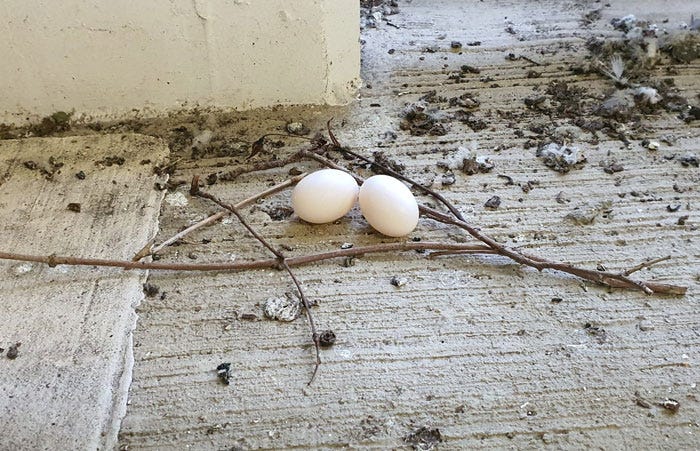
I never did complete the Glittering Sphere. I realized early on I was out of my depth and the amount of planning required felt too heavy-handed for the lightness I was trying to create. It is uncomfortable to confront that there is a density to simplicity; the most elegant work in existence stands on an invisible mountain of skill. I ended up with a stick mess because I approached with string a problem that called for…glue? Cement? There was nothing fundamentally wrong with my idea or my materials; looking back, I simply didn’t have the right attitude to execute it (read: I thought simplicity should be easier). And there’s another deeper underlying idea in all of this: I wanted to try my idea with the thread more than I wanted any specific outcome. If I’d done what would have worked, then what? I prove that glue is sticky? Using thread brought with it an element of performance art, and with that a level of uncertainty, and with that the opportunity to be surprised. This causes a lot of tension in my life, however, because what is vision for if I’m never really working toward it? I like to fool myself into believing I want one thing when really what I want is a context for exploration. If I say I want the moon, is it enough to let it hang above me in the night sky illuminating my path as I meander through the forest, with no intention of actually traveling to the moon?
My life now feels less like The Glittering Sphere in all its protection and beckoning to adventure and much more like the fragile stick mobile, random pretty ideas attached to a confused, precarious structure, and some gold paint off to the side that hasn’t yet made it onto the scene. It’s easy to think that I wish my life resembled an organized globe with perfectly spaced beads of gold and glittering light emanating from it. But I know that when I was younger I was more or less allergic to anything that resembled a path someone else had forged. I was hellbent on cultivating surprise, opportunity, and not knowing what was coming next. Have I failed? Have I succeeded? One thing I know: I’ve grown up and now know to appreciate and welcome the effort required to create work that looks effortless in its simplicity and elegance. All the planning, practice, careful attention, and understanding of what will work is the work. Fifteen years ago, it felt like I was torturing beauty, trying to extract it from a process that may have had steps that felt ugly or rough in their practicality (read: lack of magic). Now, I’ve made my peace with the complexity that underlies simplicity, the weight required to build something light. There’s a more difficult balance to strike in creating truly great work: how to create harmony between an encounter with the divine and only your earthly, human self to tell the story.
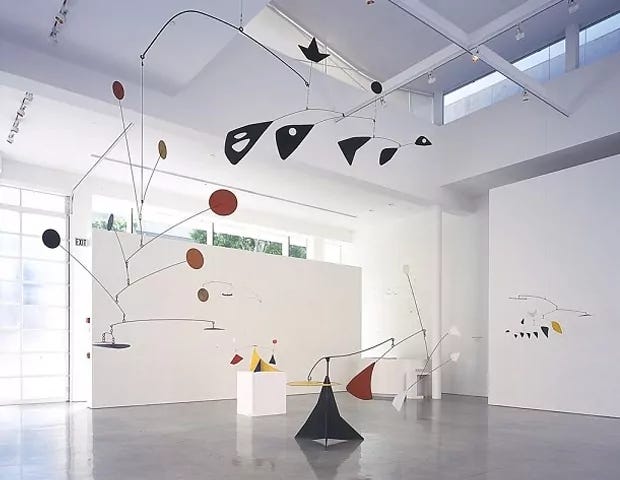
This is poetry